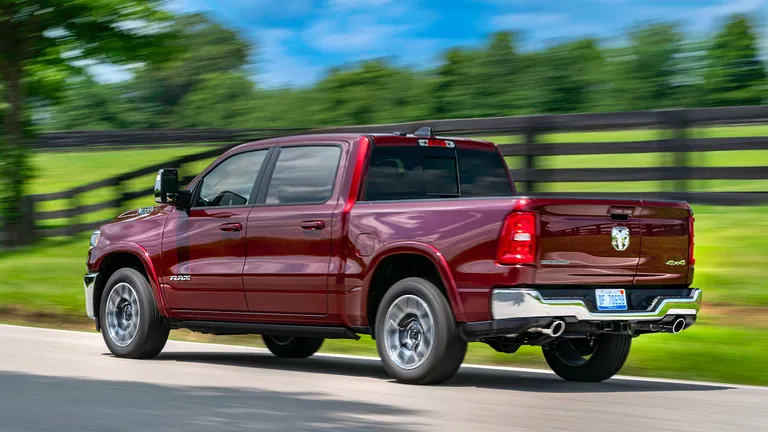
You read about our 2025 Ram 1500 Laramie 4x4 hitching up a 6,900-pound MasterCraft wake boat for Update 4: Trailering Deep Dive ↗. What you didn't read about: the truck has been connected to DIMO the whole time, streaming every signal it generates. Nine months. 3.9 million rows. Each one cryptographically signed and owner-consented for publication, downloadable at the bottom of the home page.
What follows is the part of a long-term test road impressions never reach: how our Laramie actually got used.
— MotorTrend Data Desk
Our Ram moved on 168 of the 260 days we watched it. On the other 92, the engine never started. When the wheels did turn, the truck averaged about 40 miles a day, and half of all trips ran 16 minutes or less. The single busiest hour of the week was Sunday, 3 PM. That isn't a commuter's profile. It's a Costco-run-and-occasional-cross-state-haul profile.
Worth sitting with for a moment, because our Laramie is optioned heavy: Trailer Tow Group ($1,695), Hands-Free Active Driving Assist ($2,495), Advanced Safety Group II ($3,315), air suspension ($1,995), Laramie Level 2 ($2,745), leather buckets, multi-function tailgate, the lot. As-tested sticker landed near $77K (see Update 4). That's a lot of half-ton sitting in a driveway 92 days a year, plus another however-many waiting for Sunday afternoon. The most expensive parking space in the household, by some margin.
The five biggest driving days all sit inside the Thanksgiving and Christmas windows. December 21 alone — the 781-mile interstate haul we replay as the hero trip on the home page — moved our Laramie 7.5% of its annual mileage in a single calendar day. Strip those five days out and the truck collapses into a local errand vehicle that happens to weigh five-and-a-half thousand pounds.
There's a buying question lurking under this that no window sticker is going to put in front of you: how many days a year does the truck actually need to be a truck? For our owner, the honest answer was five. The other 258 days, almost anything with four wheels would have moved the same people and the same stuff — a Ford Maverick for a fraction of the gas, or the family sedan when the boat wasn't involved. The math gets uncomfortable in a hurry.
Across nine months of the worst kind of test conditions for a half-ton's fuel economy — short suburban trips that never let the Hurricane I-6 settle in, a Michigan winter (cold-soaked starts and denser intake air), the towing weekend in Update 4 (the data shows 7–10 mpg through the boat-pull portions), and one 781-mile interstate haul — our Ram averaged 16.40 mpg over 10,002 miles and 609.9 gallons of pump fuel. The owner's own fuel log, kept on receipts at the pump, lands at 16.57 mpg over the same window. The two numbers agree to within a fifth of a mile per gallon.
EPA combined is 20. We came in at 16.4, eighteen percent off. That's the boring half of the real-world truth that every long-term test eventually uncovers: the lab number is a ceiling, and a four-wheel-drive crew-cab half-ton in mixed suburban + Michigan-winter use is not going to clear it. The Hurricane I-6 + ZF 8HP70 combo is more efficient than the 5.7-liter Hemi it replaced — the conventional wisdom is the V-8 would have landed in the 12–14 range on the same drives — but the brochure number was always aspirational. At $3.40 average pump price, that's $2,073.63 to move our long-termer 10,002 miles — about 21 cents a mile, fuel only.
Tank-size calibration footnote. The 2025 Ram 1500 Laramie 4x4 with the Max Fuel Tank package carries 33 gallons. The dash `fuelLevel` signal is nonlinear — gauge pegs at 100% for the first few gallons after a fill, triggers low-fuel with ~3 gallons still in tank. The gauge's 0–100% swing represents roughly 25 gallons of actual fuel transit. Calibrated against the owner's 29-fill pump-receipt log, the DIMO gauge math lands within 0.17 mpg of receipt truth. An earlier draft of this page reported 19.96 mpg using a 20-gallon effective swing — that calibration matched the truck's in-dash MPG display but undercounted gallons against actual pump receipts by about 19%. See methodology.
Our Ram spent the test winter in Detroit. Seventy-seven mornings the data caught a cold-soaked start (anything under 32°F counts). The worst of them was a 3.2°F ambient that took 3 minutes 22 seconds to bring the cabin up to operating temperature. By any honest measure, this is the climate the remote-start feature was specced for.
The owner used it twelve times.
Twelve. Once every twenty-two days, in the part of the country where remote-start is one of the headline reasons salesmen tick the Laramie box for you. The data doesn't tell us why — maybe the fob doesn't reach the truck through two interior walls and a garage door, maybe the cabin warms up fast enough between the kitchen and the curb. Either way, the salesman's pitch about remote-start being the cold-weather feature meets a different reality when somebody actually living in that weather hands you their nine months of usage data. Twelve.
Four-and-a-half hard-brake events per trip sounds high until you plot them on a map. They pile up at the same handful of Detroit-area intersections that any local could name without thinking. Not the truck, not the driver — the geography. (Our long-termer's brake-pad replacement will probably want to argue this point in another twenty thousand miles. Carry on.)
The fastest the Ram went, ever, across the entire observation window, was 103 mph. Once. The telemetry records when it happened and where, and not much else. Whether that was a misjudged passing maneuver on US-23 or an empty stretch of I-75 with somebody's foot getting curious, the dataset isn't going to litigate. What the dataset will tell you is this: every modern truck already knows what we just told you. The Ram has always known its own top speed. Until DIMO, the only person who couldn't see the number was the person who paid for the truck.
After nine months of reading our long-termer's own sensor data, the part that sticks isn't a number. It's how rarely the truck-ness of this truck actually got cashed in. The Ram drove exactly the way the spec sheet warns a loaded half-ton will: heavy, thirsty, optioned to the gills. For five days of real haul work and 258 days of being a $77K errand vehicle. Not a strike against this Ram. Just something to know before you sign the same option list.
If you're cross-shopping a Laramie, the most useful number in your conversation won't be on the window sticker. It's the answer to "how many days a year do I need this to be a truck?" If yours is a lot, the Ram is going to give you a comfortable, capable place to be. If yours is a handful, a Maverick or a Santa Cruz will move you and your stuff with less drama at the pump, and you can rent capability the four times you actually need it.
Nine months of telemetry settled this for our owner. Most owners don't have that. Most owners are going to have it.
— MotorTrend Data Desk · Companion to Update 4: Trailering Deep Dive. 263 days of telemetry, one truck, no edits to the underlying numbers.
This report was written by a DIMO AI agent with granted access to the vehicle data.